
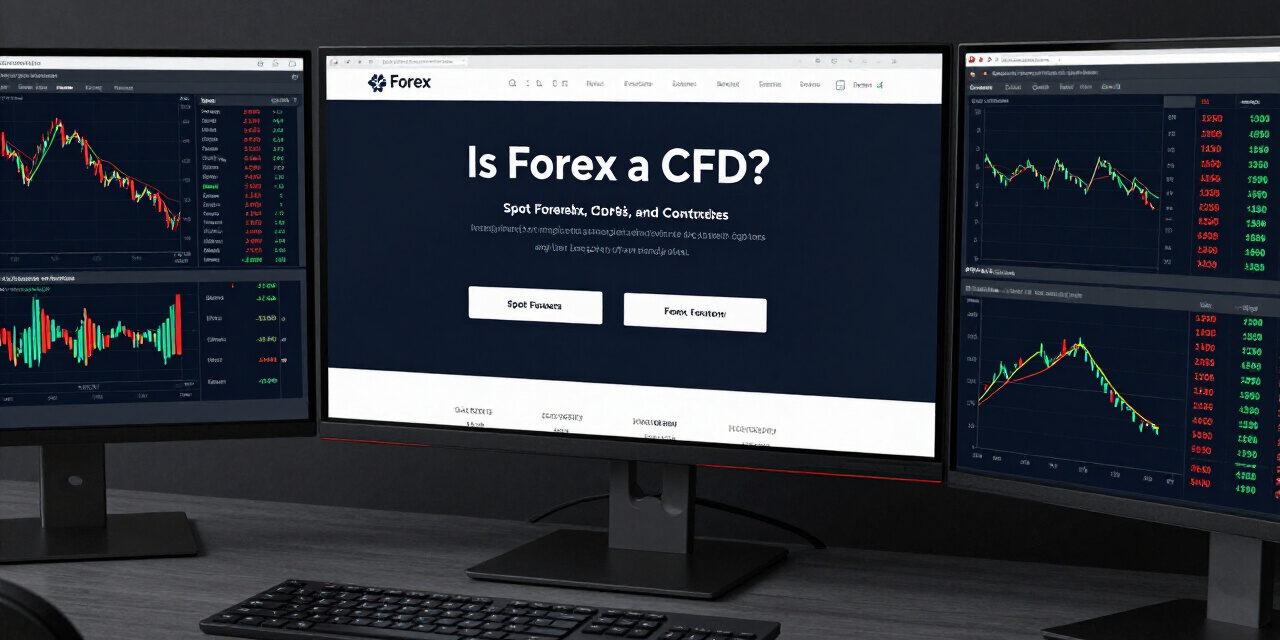
Spot Forex and Contracts for Difference (CFDs) represent distinct financial instruments often conflated by retail traders despite having fundamental structural differences. Spot Forex involves the simultaneous exchange of currency pairs for immediate delivery, functioning as a decentralized global market. Conversely, CFDs are derivative products that allow traders to speculate on price movements without owning the underlying asset, introducing leverage-based risks and financing costs.
Understanding these mechanisms is vital for effective capital allocation and risk management. While indices typically trade exclusively as CFDs, currency markets oscillate between spot transactions and derivative exposure depending on the broker’s platform architecture. Mastering the distinction between direct market access and synthetic exposure determines your execution efficiency and fee structure. This analysis clarifies the regulatory nuances and technical execution requirements for traders navigating these high-liquidity financial ecosystems, ensuring you avoid common pitfalls associated with misaligned asset classes.
What Is Spot Forex Trading?
Spot Forex trading involves the immediate exchange of two currencies at the current market price for settlement within two business days. This decentralized, over-the-counter market facilitates global trade by allowing participants to exchange fiat currencies directly without a centralized clearinghouse, focusing purely on the exchange rate value between currency pairs.
Spot Forex operates as an over-the-counter market where participants buy and sell currency pairs. You can learn more about the operational structure of the global market by reading our guide on what is forex trading to understand how liquidity providers sustain pricing.
In this arrangement, the transaction involves the actual delivery of the traded currency assets. Banks and large financial institutions use this mechanism to settle international trade payments. Retail traders usually participate through intermediaries to speculate on price fluctuations between the bid and ask price.
- Because there is no physical exchange location, liquidity is sourced from a network of global banks.
- This structure ensures that market prices reflect real-time economic data and interest rate differentials.
- It remains the backbone of the international monetary system, distinct from derivative contracts.
Execution in the spot market is rapid and relies on high-speed telecommunications. Unlike derivative products, spot trading requires an understanding of how currency supply and demand interact globally. Traders must account for rollover interest, known as swap points, if they hold positions past the daily market close.
What Is a Contract for Difference (CFD)?
A Contract for Difference is a derivative product allowing traders to speculate on the price movement of an underlying asset without owning it. You enter a contract with your broker to exchange the difference in the asset’s value between the opening and closing times of the trade.
When you trade CFDs, you are not buying the underlying stock, commodity, or currency pair. Instead, you are betting on the direction of the price. If your prediction is correct, the broker pays the difference. If incorrect, you pay the broker the difference in cash.
CFDs offer a flexible way to gain exposure to markets that might otherwise be inaccessible. Because you do not hold the asset, you avoid costs associated with physical delivery or custody. Many traders prefer best forex brokers who provide diverse CFD instrument libraries for portfolio diversification.
- Margins are a fundamental component of CFD trading.
- They allow you to control a large position with a smaller initial deposit.
- This mechanism requires careful risk management, as it increases the potential for both gains and losses.
- Always verify the margin requirements before opening any position.
Regulatory frameworks for CFDs vary significantly by jurisdiction. Some regions restrict the amount of margin gearing allowed for retail clients to protect them from excessive exposure. Understanding these legal constraints is vital for anyone planning to trade derivatives rather than physical spot currency markets.
Key Differences Between Spot Forex and CFDs
Spot Forex involves the direct exchange of currencies with potential physical settlement, whereas CFDs are synthetic derivative contracts settled in cash. While Spot Forex deals with the exchange rate itself, CFDs mimic the price action of an asset, including currencies, commodities, indices, and individual company stocks.
The primary distinction lies in ownership and delivery. In a spot transaction, you theoretically own the currency you purchase. In a CFD transaction, you own nothing but the contract. This impacts how the trade is settled and the regulatory oversight governing the transaction type.
Taxation often treats these two instruments differently depending on your country of residence. Some jurisdictions provide tax incentives for spread betting or specific derivative products, while physical currency holdings might fall under capital gains tax laws. Consult a tax professional regarding your specific financial situation.
- Transaction costs also differ.
- Spot Forex trading is often commission-based with tighter spreads provided by liquidity banks.
- CFD trading often incorporates the cost of the trade into a wider spread or charges a separate commission.
- Costs vary widely across different brokerage models and execution styles.
Finally, the lifespan of a trade differs. Spot positions can be rolled over indefinitely, provided you maintain sufficient margin. Some CFDs on indices or commodities have expiration dates, forcing you to close or roll the position. Always check the contract specifications for any derivative product you intend to trade.
How Stock Indices Derivatives Differ from Currency CFDs
Stock indices derivatives track the performance of a basket of equities rather than a single currency pair. While currency CFDs respond to interest rate shifts and geopolitical data, indices CFDs reflect the aggregated sentiment, earnings performance, and macroeconomic health of the specific companies composing the index benchmark.
Trading an index like the S&P 500 requires analyzing corporate earnings, interest rate cycles, and sector performance. This differs from currency trading, which focuses on national central bank policies and trade balances. Both are speculative, but the catalysts for price movement are fundamentally distinct in nature.
Many traders use indices as a proxy for the health of a national economy. When the index rises, it often suggests investor confidence in corporate profitability. Currency pairs, by contrast, indicate the relative strength of two different economies. Integrating both into your strategy can provide a macro perspective.
Trading Global Indices via CFD
- Indices are popular because they represent broad market sentiment.
- By trading a CFD on an index, you gain exposure to the top companies in a region without needing to pick individual stocks.
- This provides instant diversification for your portfolio, reducing the risk associated with a single company’s failure.
Key specifications for index CFDs include the tick size, the contract value, and the trading hours. Because indices move based on corporate data, volatility often occurs during the opening and closing hours of the primary stock exchanges. Monitoring these windows is essential for effective index trading.
Currency CFD Specifics
Currency CFDs function exactly like currency spot pairs in terms of visual charting and price behavior. However, the legal contract is a derivative. You should treat them with the same risk management protocols used in spot trading. Always monitor the margin requirements to ensure your account remains safe.
Market hours for currency CFDs are near-continuous throughout the week. Because global currency markets operate in shifts, liquidity remains high. This enables traders to find entry points across various time zones. Use professional tools to track these sessions for consistent execution performance during 2026 September.
Frequently Asked Questions About Forex CFDs
Common questions regarding Forex CFDs focus on the differences between spot markets and derivatives, margin requirements, taxation, and the actual ownership of assets. Understanding these fundamentals helps traders select the correct instruments for their personal investment goals while maintaining strict risk management protocols during their active trading sessions.
- Is currency trading always a CFD? No, you can trade currencies in the spot market without a derivative contract.
- Do I pay taxes on CFD profits? Tax laws depend on your residency and the classification of derivatives in your region.
- Are index CFDs safer than Forex? Safety depends on your position sizing and risk management, not the instrument type itself.
- What is the main risk of CFD trading? The primary risk involves the use of margin gearing, which can amplify losses rapidly.
- Can I hold CFDs forever? Most have no expiration, but some commodity-based CFDs may have set contract terms.